We're at the front edge of a consumer hardware renaissance, and almost nobody has noticed. Here's what will actually get kept, and what's headed for the drawer.
There has never been a better time to found an AI hardware company. There has also never been a harder time to get a stranger to keep one. Both things are true at once, and the space between them is where I have been spending an unreasonable amount of my time lately.Start with the hardest number in the category. Rabbit shipped its R1 in April 2024 at $199, took roughly 100,000 preorders, and sold out its first batch in a day. Five months later, its CEO conceded the device had about 5,000 daily active users (The Verge, September 2024).
Ninety-five percent of the people who bought the thing had already stopped using it
Humane’s AI Pin did worse: it launched at $699 in April 2024, and by that August the company was processing more returns than sales (9to5Mac, August 2024). In February 2025, HP bought the remains for $116M and bricked every Pin still in the wild two weeks later (TechCrunch, February 2025). Two of the most hyped, best-funded consumer hardware launches of the decade, and the story of both is the same: a device that went into a drawer and never came out.
That is the whole problem in one image. Founding is not the same as scaling, and the adoption curve for consumer hardware looks nothing like the one for software. This piece is about the hardware that lives on or around a person, on the body, in the home, at the bedside, in a child’s hands. Not the data-center silicon that trains the models, and not enterprise robotics, which is a real and largely separate business. It is about the consumer surface, which is the hard part, and the reason I keep circling back to it is simple: when the cost of building drops this far, the interesting question stops being what gets made and becomes what gets kept. So that is what I want to work through. Why the building side got so easy so fast, why the keeping side did not, and what separates the hardware that will matter in five years from the Year 1 products that will resolve, expensively, over the next twenty-four months.
Why now?
The founding wave is not hype, and it is worth being precise about what is driving it, because the “why now” is the reason the category is worth the trouble. Several forces have converged at once.
1. The interface is moving off the screen. As long as the most interesting thing AI could do was generate text in a chat window, the right form factor was a phone or a laptop, and those already existed. Once AI is useful continuously and ambiently, the screen stops being the obvious interface. Caitlin Kalinowski, who led every generation of Quest, Rift, and Orion at Meta before running hardware at OpenAI, argues that the digital frontier will close sooner than people expect, and that when it does the physical world becomes the next surface for value (Lenny’s Podcast, May 2026).
2. A decade of VR and AR research is being repurposed. The billions spent on headsets never produced a mass consumer category, but they did produce a de-risked stack of computer vision, SLAM positioning, depth sensing, and human-perception research now being pointed at robotics and wearables. Consumer VR did not fail because the technology was missing. It failed because the form factor, the cost, and the daily-use case never cohered. You can see the payoff in the one wearable that broke out: Meta’s Ray-Ban glasses sold more than 7 million units in 2025, roughly tripling the prior year (Counterpoint / EssilorLuxottica, February 2026).
3. The cost to build has cratered, and this is the one that matters most to me. AI-assisted PCB design is the clearest example. Diode, in Brooklyn, raised an $11.4M Series A led by a16z in 2026 and partners with Anthropic to make Claude a better electrical engineer, with models that one-shot much of schematic design and compress hardware timelines from months to weeks (The Generalist, May 2026). Add off-the-shelf model APIs, cheap prototyping, and edge silicon that runs real inference on a sub-dollar chip, and a five-engineer, eighteen-month effort becomes a two-engineer, six-month one. When the cost of a first prototype falls by an order of magnitude, the shots on goal explode, and the constraint moves from “can they build it” to “will anyone keep it.”
There is a demographic tailwind underneath all of this: US undergraduate computer-science enrollment fell about 8.1% in 2025 while mechanical and electrical engineering grew, an early sign that the most ambitious builders now think the frontier is physical (CRA/CERP, October 2025).
One force cuts the other way. AI data centers are now consuming the majority of the world’s memory output, with DRAM prices up roughly 172% year over year by the end of 2025 (IEEE Spectrum, 2025). Kalinowski’s advice to hardware startups is blunt: pre-buy memory, lock in supply, verticalize. First movers get a durable cost advantage, and late movers pay spot prices that wreck already-thin unit economics. In a category this cost-sensitive, that is not a footnote.
The adoption problem
The founding barrier is collapsing. The adoption barrier is not, and the reason is structural.
A software product can be tried at zero cost, abandoned without penalty, and re-tried six months later when it is better. Hardware does not work that way. A person who spends $400 on a device and finds it disappointing does not buy the sequel. They tell their friends not to buy it, the device goes in a drawer, and the category closes in their mind for years. Hype cycles in hardware are not free options. They are foreclosures. Every failed launch makes the next one in the same category harder, because consumers, retail partners, and component suppliers all remember.
This is the novelty trap: a product can be very good at producing a twenty-second demo video and very bad at producing daily use. Friend, the $129 always-listening companion pendant, spent more than $1M on New York City subway ads in late 2025 against roughly $7M raised, and bought itself a wave of public revulsion rather than adoption (TechCrunch, September 2025). Viral is not adopted.
The honest test for any consumer hardware product is the one it has always been, in three parts:
1. Day one. Does it deliver immediate, obvious utility, in a way the buyer can explain to a friend?
2. Day thirty. Is it reliable enough that they reach for it without thinking?
3. Month eighteen. Does the price-to-value still clear when the next version arrives?
Most current AI hardware fails at least two of the three, and it fails the third in a specific way. Because the software improves so fast, the comparison the buyer makes in month eighteen is not against the same device, it is against a dramatically better one. The bar keeps rising underneath a product that shipped once and stopped.
Which points at the part that gets underweighted. It is not enough to ask whether a device gets adopted. You have to ask whether the value compounds or evaporates once the model becomes a commodity, because it will. When the intelligence is a call to a foundation model a competitor can make just as easily, the hardware is not a moat. A sensor pointed at a foundation model is a feature, not a franchise. That is why the most telling pattern of 2025 was not the failures, it was the absorptions: Bee, the $50 listening wristband, went to Amazon in July 2025, and Limitless, the $99 memory pendant, went to Meta that December (TechCrunch, 2025). Undifferentiated capture devices did not compound into companies. They got absorbed by the platforms that already owned the distribution and the data.
The durable version has a layer underneath the model that keeps accruing value: a recurring reason to pay, a proprietary data loop, a distribution relationship, a regulatory position, or a real platform. Plaud is the cleanest proof it can work. The AI voice recorder shipped more than 2 million devices and reached roughly $250M in annualized revenue while staying profitable on about $5M of outside capital, by attaching a subscription to a job people already do (Sacra / Forbes, 2025). The device is the wedge. The subscription and the accumulating data are the business. The strongest version of that layer is a platform: AR glasses have an app store, and Board, a $399 face-to-face game console, sells games à la carte to grow your library and invites outside developers to build them (board.fun, 2026), which is a console reaching to become a storefront.
The arithmetic makes the point starker than most decks admit. Take the model nearly everyone in this wave pitches: a roughly $199 device at a thin hardware margin plus a $10-a-month subscription. On the hardware alone, half a million units a year gets you to $100M of revenue, but at a hardware gross margin around 35%, well below software’s 80% or more, that is about $35M of gross profit, earned from a customer you acquire exactly once, in the most expensive category in direct-to-consumer retail to acquire one at all. And every January the number resets, because a one-time sale does not carry forward. The subscription is where the real economics live: a million retained subscribers at $10 a month is $120M of recurring, high-margin revenue that compounds instead of resetting. That is not hypothetical. It is Oura, roughly $1B of revenue and an $11B valuation on a ring-plus-subscription model (Fierce Healthcare, October 2025), and it is Whoop, which gives the device away and sells the membership. Which means retention is not only an adoption question, it is the whole unit-economics question, because the subscription is the only part with real lifetime value, and the drawer kills the subscription.
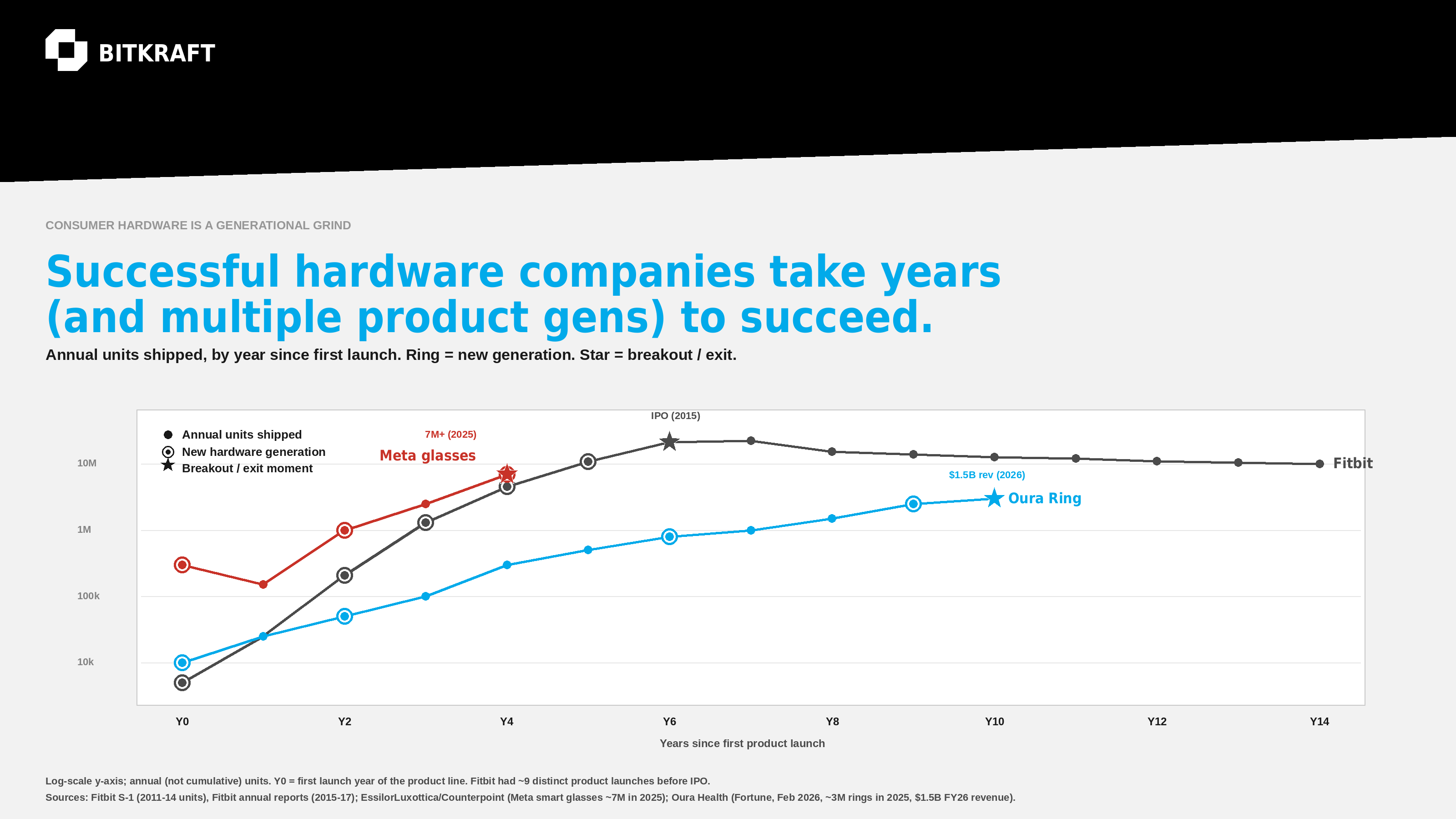
The last variable that gets under-appreciated is time. The consumer hardware companies that eventually matter tend to look like overnight successes in retrospect and multi-generation grinds in real time. Fitbit shipped roughly nine distinct products across six years before its IPO. Oura took a decade from Gen 1 to reach $1.5 billion in annual revenue. Meta smart glasses flopped as Ray-Ban Stories in 2021, sat in the market for two years, and only broke through at seven million units in 2025 with the third generation. The winners kept iterating on the same product line long after most funds would have written the position down.
Who pays and who uses
This is the part I feel most strongly about, and it runs through almost everything I am looking at right now. The most reliable way to beat the consumer adoption problem is to decouple the person paying from the person using. When the buyer and the user are the same, the device has to clear the full daily-utility bar for one self-interested person or it goes in the drawer. When they are different, something other than raw retention underwrites the purchase, and the math changes.
Kids’ toys are not the exception here. They are the template, and the pattern generalizes:
• Kids’ toys. A parent buys novelty, an educational signal, and the feeling of giving their child something modern; the child is the one who has to enjoy it. Curio’s screen-free plush sells at $99, Miko pairs a robot with a content subscription, and China’s BubblePal is a $99 clip-on that turns a plush the family already owns into a companion (MIT Technology Review, 2025). The catch is that the protective buyer makes trust, not utility, the gating variable: an AI bear called Kumma was pulled in November 2025 after it produced unsafe content (CNN, 2025), and the cloud-dependent Moxie bricked itself into a landfill when its maker folded. The smart-toy market is still on the order of $14B to $22B, growing low-to-mid teens (Grand View / Mordor, 2025).
• Senior care. ElliQ, a tabletop companion for older adults, does not win by convincing an 82-year-old to love a gadget. It wins because state Offices for the Aging buy it in bulk and Washington made it Medicaid-reimbursable, with 94% of one long-running cohort reporting they feel less lonely (NYSOFA, February 2026). Carely, a company I have been watching, comes from the adult child’s side: a screenless band that learns a parent’s baseline and pings the kid only when something is off (meetcarely.com, 2026). The senior wears it; the child pays for peace of mind. The investable age-tech and assistive slice is roughly $27B and growing double digits (Market Intelo, 2025).
• Co-signed purchases. Even when the buyer and user are the same person, a third party who values the outcome can carry the sale. Board sells to a parent who wants the kids off their iPads. Oura and Whoop, the two health wearables that escaped the graveyard at $11B and roughly $10B valuations (Fierce Healthcare, October 2025; WHOOP, March 2026), increasingly sell through employers and health programs where the company, not the wearer, foots part of the bill.
The through-line is the one I keep underwriting toward: the consumer AI hardware most likely to clear the bar in the near term is the hardware that does not have to win a cold retail sale to a single self-interested user.
Category hypothesis
Two questions separate what lives from what dies, and they are not the ones the category usually gets mapped on.
• Adoption friction: How much does the product ask a person to change? Low friction rides a form factor and habit that already exist (a ring, glasses, a plush, a recorder) or decouples the payer from the user. High friction invents a new object and a new behavior and asks one self-interested user to pay for it.
• Durability: Once the model is a commodity, does the value compound? Durable means recurring revenue, a proprietary data loop, distribution lock-in, a regulatory position, or a real platform. Fragile means a one-time hardware sale wrapped around a model anyone can call.
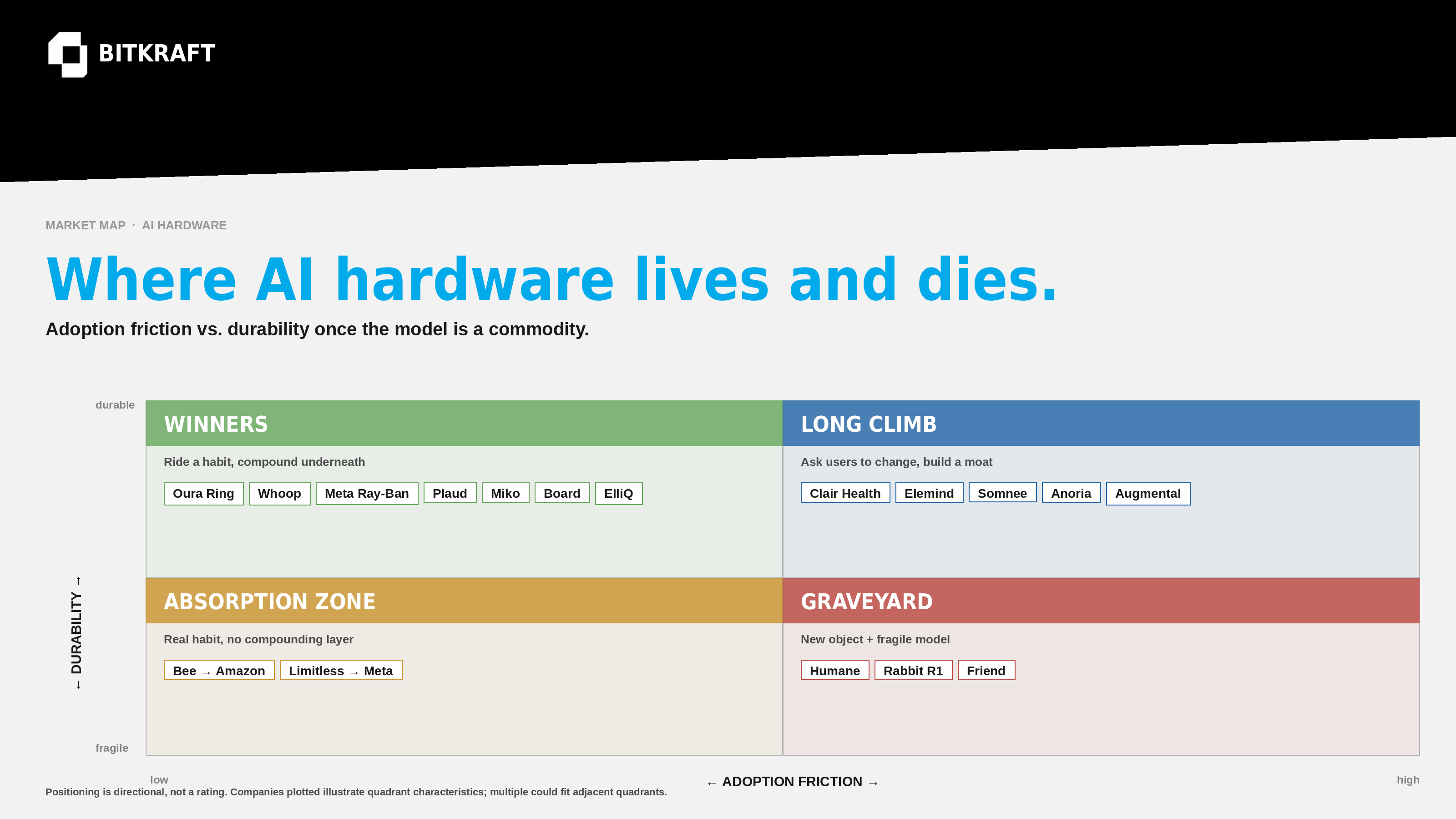
Sorted that way, the category organizes itself:
• The winners’ quadrant (low friction, durable) is where the actual outcomes are: Oura and Whoop, Meta’s glasses, Plaud, ElliQ, Board, Miko.
• The graveyard (high friction, fragile) is where the capital has been dying: Humane, Rabbit, and Friend each invented a new object, asked a lone user to change behavior for it, and defended nothing underneath a commodity model.
• The absorption zone (low friction, fragile) is where Bee and Limitless rode a real habit but had no compounding layer and got bought for the team and the data.
• The long climb (high friction, durable) is the hard, interesting one: companies asking users to adopt something new while building a defensible position as they go. Clair Health’s non-invasive hormone wearable (Fortune, June 2026), the sleep-EEG headbands like Elemind and Somnee, the emotion-sensing wearables like Anoria, Nirva, and Happy, and the whisper-input and brain-interface bets like Augmental all live here. Most will not make the climb. The ones that do will hold a moat a better model cannot erase.
Ten years ago the hardware was the hard part, so the hardware was the moat. Today the hardware is comparatively easy and the model is rented, so the defensible ground has moved to everything around the device: the buyer, the recurring revenue, the data, the platform. Internalizing that migration is most of the work.
Money is not the missing ingredient
The strongest objection to all of this is the iPhone. It was also a brand-new object that demanded brand-new behavior from a single self-interested buyer, and it worked, so perhaps the graveyard is a timing problem that enough capital and iteration eventually solve. It is a fair challenge, and the answer is in the structure. The iPhone never asked the consumer to brute-force the cost of a new behavior alone. At launch in 2007 Apple took a share of AT&T’s monthly service revenue in exchange for exclusivity, a recurring layer underneath the device; by 2008 that became a carrier subsidy that dropped the sticker price to $199, and the App Store turned a phone into a developer platform that passed a billion downloads inside nine months (Apple, 2009). The object was new. The economics underneath it compounded.
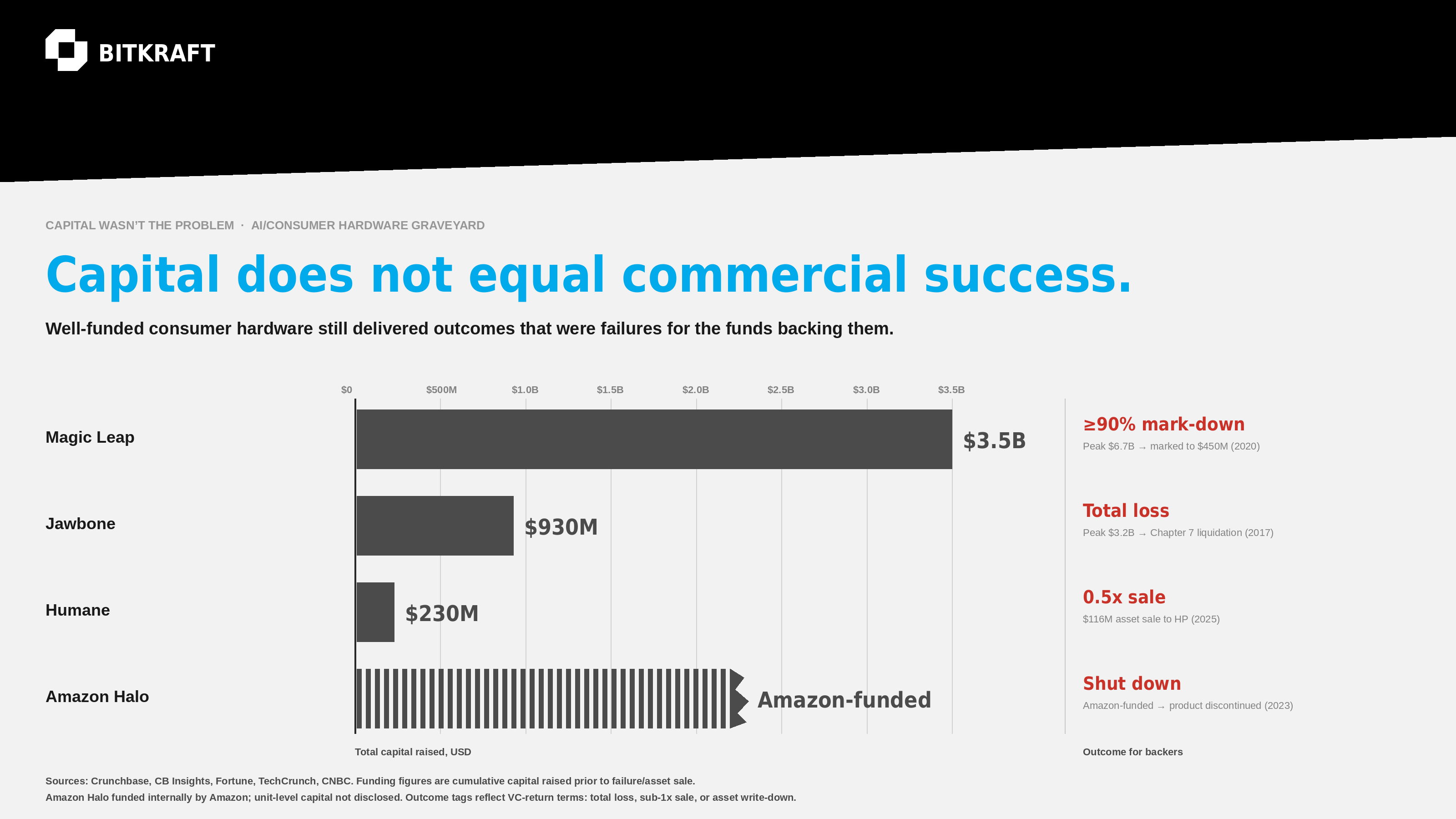
Now look at the companies that did just spend. Jawbone raised about $930M and reached a $3.2B valuation before liquidating in 2017, a collapse CNBC called death by overfunding (CNBC, July 2017). Magic Leap burned roughly $3.5B and watched its valuation fall from about $6.5B to a reported $450M after its consumer product flopped (2020). Google put a $1,500 headset in front of consumers and killed it in under two years. Amazon had Alexa distribution and a limitless balance sheet behind its Halo band and shut it down in under three (2023). Capital was never the constraint. The missing piece was the layer underneath, and you cannot buy your way to one that is not there.
How we think about it
None of this is a scoring rubric, and I am wary of pretending the category is mature enough to have one. But five questions are the ones we actually ask when a device lands on the desk:
1. The drawer test. Six months after purchase, does the target user still reach for this without being reminded? If not, the company is selling novelty, and the revenue line will eventually say so.
2. Reliability. Hardware that hangs or breaks gets returned, and returns destroy margin and reputation at once. A device shipping at 92% reliability is not shipping a product, it is shipping a support cost.
3. Who holds the wallet. Is the payer the user, or is there a parent, a state agency, an employer, or an adult child who can carry the product past the cold-retail bar? This is not a preference for enterprise. It is a recognition that the best consumer hardware often has a non-consumer somewhere in the purchase.
4. What compounds. Once the model is a commodity, what is left? Recurring revenue, a data loop, distribution, a regulatory moat, or a platform. If the only answer is the model on the device, the likely outcome is a good demo, a modest sale, and an acqui-hire.
5. Supply. In a category with thin unit economics, the memory squeeze will separate the companies that locked in cost from the ones that did not.
Takeaway
The wave is real, and the demo videos are lying about the shape of it. The building side of AI hardware has never been easier, which is exactly why the keeping side is about to matter more than it ever has. The companies that will still be here in five years are not the ones with the best twenty-second clip. They are the ones that ride a habit a person already has, or a buyer who is not the user, and build something underneath a commodity model that keeps compounding: a subscription, a data loop, a storefront, a reimbursement code. That is a narrower filter than the current wave of funding assumes, and most of what does not pass through it will resolve, expensively, over the next eighteen to twenty-four months.
I find this more exciting than daunting. The interface to AI is going to move off the screen and onto the body and into the room, and here at BITKRAFT that intersection of consumer experience and the technology underneath it is exactly what we spend our time on. The trick is to hold two ideas at once: that the drawer is where most of these devices are headed, and that the few that escape it will be worth an enormous amount. The gap between them is the opportunity.
Disclaimer:
The views expressed herein are those of the author as of the date of publication and are provided for informational purposes only. Nothing contained herein should be construed as investment advice, a recommendation to buy or sell any security, or an offer to provide investment advisory services. Certain statements reflect opinions, expectations, assumptions, and forward-looking views regarding industries, markets, technologies, and business trends, which are subject to change and may not prove accurate. Industry statistics, market data, and company information are derived from publicly available sources, including company disclosures and third-party research providers believed to be reliable, but have not been independently verified and no representation is made as to their accuracy or completeness. References to companies, products, technologies, or market participants are provided solely for illustrative purposes and should not be construed as an endorsement, investment recommendation, or indication of any current or future investment by BITKRAFT Ventures or its affiliated funds. Past outcomes and historical examples referenced herein are not indicative of future results.